Grants
Micro-Grants
EAMCEF offers micro-grants up to Tsh 10.0 million for small-scale projects and feasibility studies. These awards are subject to internal merit review and approval by the Executive Director. Projects typically run for 6 to 12 months.
Medium or Discrete Project Grants
EAMCEF funds one-time projects lasting up to 36 months. Grants range from Tsh 10M to 100M per year (averaging Tsh 10M–50M). Following internal and external technical reviews, all proposals require Board of Trustees approval.
Multi-Year Programme Grants
EAMCEF provides funding for complex programmes requiring more than three years to achieve lasting impact. Grants are capped at Tsh 100M per year. Proposals undergo internal and external technical reviews and require final approval from the Board of Trustees.
Central Government Departments, District Councils, government agencies, NGOs, CBOs, Local Communities, Research Institutions, Academic Institutions and Individuals are all eligible for submitting Project Proposals. Before formal submission, the proposal may be discussed with appropriate EAMCEF Secretariat staff. Undergraduate and Postgraduate students are encouraged to submit research proposals, but also can arrange to serve as research assistants to faculty members. In some cases EAMCEF may accept proposals to partly fund Doctoral Dissertations or Research Grants when submitted by a faculty member on behalf of the graduate student if the research is of great interest to the Fund. The Fund also provides support specifically for women and minority groups in the targeted communities in the aspects of Income Generating Activities (IGAs), Social Welfare as well as Community Development projects.
EAMCEF strives to identify groups, individuals, and organizations that can make an effective contribution to the conservation of the Eastern Arc Mountains. Moreover, EAMCEF seeks innovative ideas and approaches that can ensure the long-term sustainability of its conservation efforts, including contributing to improving livelihoods of communities affecting in some way the forests of the Eastern Arc Mountains. Contingent upon submission of feasible proposals the following entities are offered project grants.
EAMCEF currently undertakes at most one call for proposals per year for community development and climate change adaptation grants, in July, contingent upon the availability of funds. The schedule for the primary call for proposal process is as follows:
Schedule of Call for Proposals –Community Grants
| July | Announce call for proposals – use local media, newsletters, website, LACs, field officers, colleagues and others to distribute announcement |
| September | Last week of September proposals due in offices of EAMCEF |
| December | Review processes completed and projects selected and ranked for funding |
| January | Board meets and reaches funding decision regarding projects |
| March/April | Funding negotiations and development of funding agreements |
| May/June | Successful candidates contacted and fund disbursement initiated |
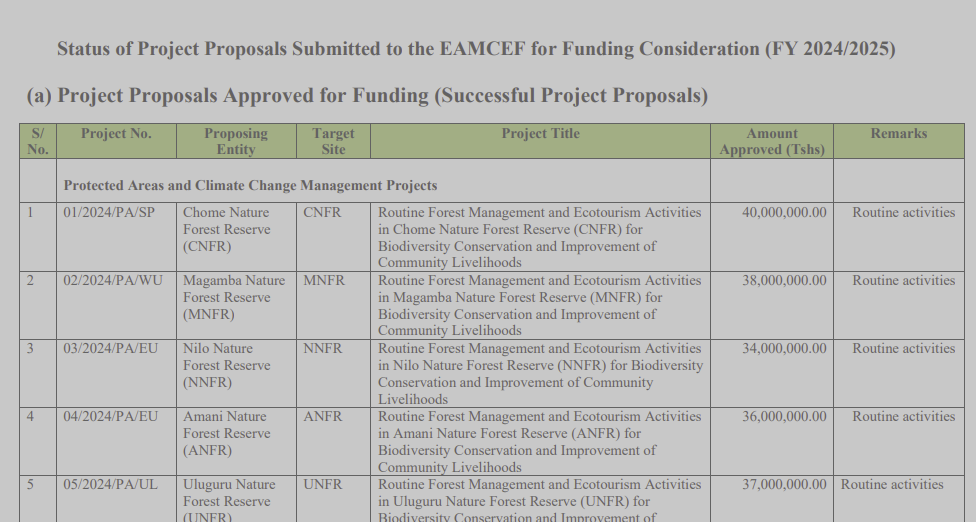
As part of our commitment to transparency and accountability, this directory serves as an official archive of funding decisions across our core thematic areas: Protected Areas and Climate Change Management, Community Development and Conservation, and Applied Biodiversity and Climate Change Research. By documenting both successful and unsuccessful applications, EAMCEF aims to provide stakeholders with clear insights into how resources are allocated to protect the “Galapagos of Africa” and support the livelihoods of adjacent communities.